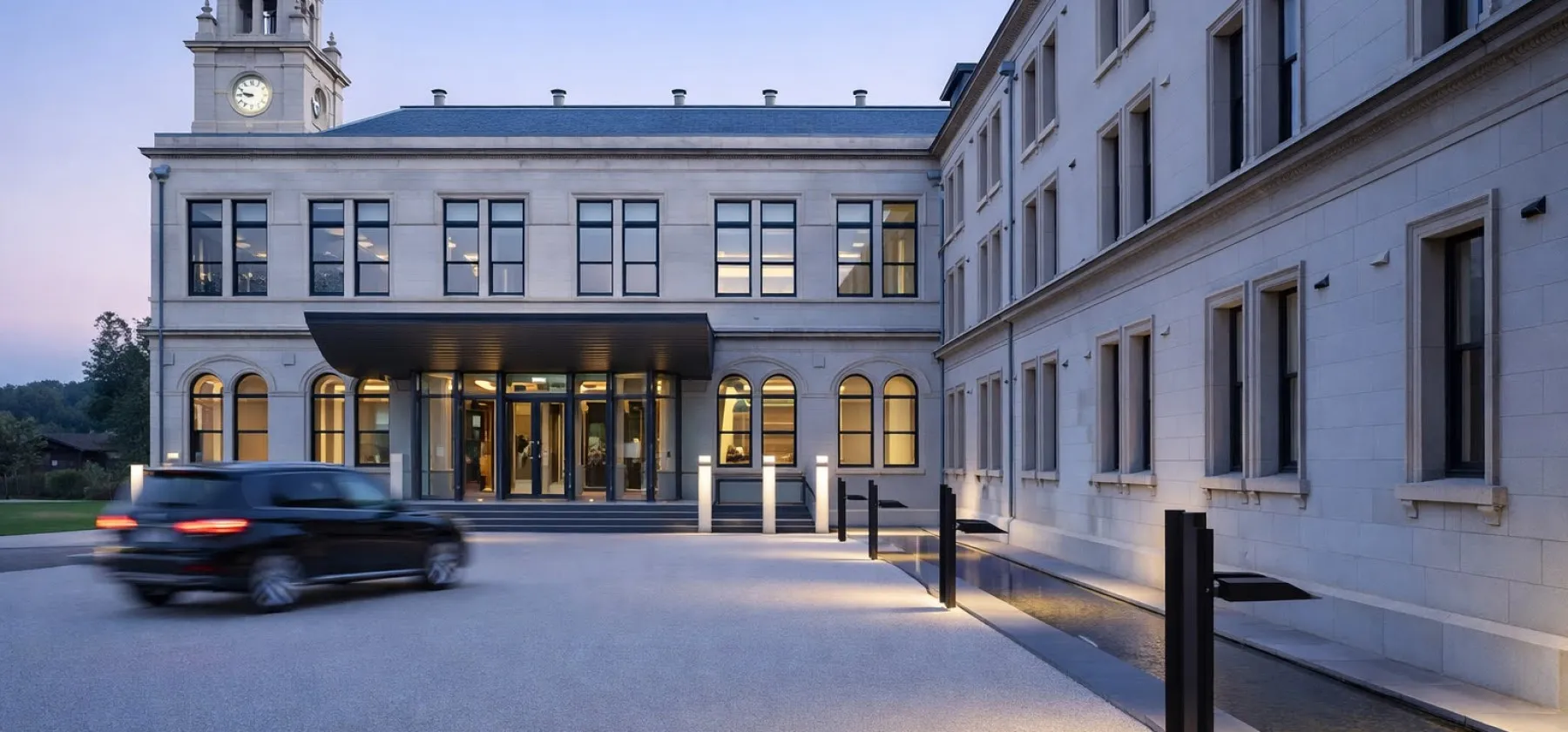

There are hotels built to look historic. And then there are places where history is quite literally built into the walls.
Lancemore Mansion Hotel Werribee Park belongs to the latter.
Set within the extraordinary Werribee Park estate, the hotel tells a story that stretches from the ambition and wealth of colonial Victoria, through decades as a Catholic seminary, to the creation of one of Victoria's most distinctive heritage hotels.
To understand the hotel, you first have to understand the estate that surrounds it.
The story of Werribee Park begins with brothers Thomas and Andrew Chirnside, Scottish immigrants who arrived in Australia in the nineteenth century and went on to build one of colonial Victoria's great pastoral enterprises.
Their wealth was built principally through land, cattle and wool, and Werribee became the centre of their growing empire.
Between 1874 and 1877, the brothers created its most enduring symbol: Werribee Park Mansion.
The grand Italianate residence was an extraordinary statement of prosperity. With some 60 rooms, imposing reception spaces, a billiard room, library, bedrooms, servants' quarters and commanding views across the estate, it was conceived on a scale rarely seen in colonial Victoria.
But the Mansion was only one part of Werribee Park.
Around it sat a vast working pastoral property: farm buildings and stables, workers and servants, agricultural land, formal gardens, an orchard and the infrastructure required to support an estate of remarkable scale.
What guests see today as beautiful parkland was once both a private country estate and a working enterprise.
The family's time at Werribee Park was not to last forever.
Thomas Chirnside died in 1887 and Andrew followed in 1890. Over the following decades, changing economic circumstances and a new generation of the family saw the vast estate progressively reduced.
Eventually, an entirely new custodian arrived.
In 1923, Werribee Park was acquired by the Catholic Church.
And it is here that the history of Lancemore Mansion Hotel itself really begins.
The former home of one of Victoria's wealthiest pastoral families took on an extraordinarily different purpose.
Werribee Park became home to a Catholic seminary, where generations of young men studied and prepared for the priesthood.
The original Chirnside Mansion was adapted to support its new life, but as the seminary grew, considerably more space was required.
New wings were constructed alongside the nineteenth-century Mansion. These additions created accommodation and facilities for the seminary community and changed the architectural footprint of Werribee Park.
Those buildings are particularly important to the story today.
Two of the wings constructed during the Catholic Church's occupation of Werribee Park would eventually become part of Mansion Hotel.
The St Joseph's wing of the former Corpus Christi College is now part of Lancemore Mansion Hotel Werribee Park.
And what are today some of the hotel's Heritage Rooms once housed students of the seminary.
The long corridors, proportions, windows and architectural details that guests encounter today weren't created to imitate another era. They belong to it.
The seminary chapter also helps explain something less tangible about Mansion Hotel.
There is a stillness to the property.
For decades, these buildings were occupied by a community whose days revolved around study, reflection, worship and communal life.
The expansive gardens and separation from Melbourne made Werribee Park particularly suited to that purpose.
Walk through the hotel's heritage wing today and traces of that former life remain: the long corridors, soaring doors, original architectural details and the historic library.
Even Joseph's, the hotel's restaurant, carries a subtle reference to the property's past through the name St Joseph's.
The luxury has changed. The sense of retreat has not.
By the second half of the twentieth century, another significant change was approaching.
The seminary era ended in the 1970s and Werribee Park passed into Victorian Government ownership.
This was a defining moment in the estate's history.
Rather than allowing one of Victoria's most significant historic properties to disappear behind private ownership or redevelopment, Werribee Park began a new life as a place that could be preserved and experienced by the public.
The original Chirnside Mansion underwent extensive conservation and restoration, while the surrounding estate began evolving into the remarkable precinct visitors know today.
Over time, Werribee Park would become home not only to the historic Mansion and formal gardens, but also the Victoria State Rose Garden, Werribee Open Range Zoo and National Equestrian Centre.
But the former seminary wings presented another question.
What should become of them?
For decades after the seminary closed, parts of the former seminary complex sat largely unused.
Then, around the turn of the millennium, Werribee Park entered another ambitious chapter.
The former seminary buildings were transformed into a luxury hotel.
Rather than erase the past, the development worked with it.
The heritage wings were retained and restored, while award-winning Melbourne architects Wood Marsh introduced contemporary accommodation and spaces alongside them.
It created the architectural conversation that still defines Mansion Hotel today: Victorian grandeur, twentieth-century institutional architecture and contemporary Australian design existing together on the same estate.
The hotel opened in 2000, breathing life back into buildings that had stood largely dormant for decades.
Today, Lancemore Mansion Hotel Werribee Park has 91 guest rooms, but no two parts of the experience tell quite the same story.
Perhaps nowhere is the hotel's past more tangible than in its Heritage Rooms.
These rooms occupy the former seminary and were once home to students preparing for religious life.
Their heritage significance meant their transformation into hotel rooms had to respect the existing building.
Today, contemporary comforts sit within those original proportions, allowing guests to experience the history rather than simply observe it from a distance.
Elsewhere, the hotel's Superior Rooms and Junior Suites form part of the later architectural transformation of the property, creating a deliberate contrast between old and new.
It is one of the things that makes Mansion Hotel unusual.
This isn't a recreation of a nineteenth-century country house.
It is a hotel that reveals the different lives Werribee Park has lived.
There is an important distinction at Werribee Park.
The magnificent nineteenth-century building beside the hotel is Werribee Park Mansion — the original Chirnside family residence, today preserved as a historic property.
Lancemore Mansion Hotel Werribee Park sits immediately alongside it and incorporates significant parts of the later seminary complex.
They are different buildings, but their histories are inseparable.
Together they tell more than 150 years of Werribee Park.
For today's guests, that creates an unusual opportunity.
You don't simply visit a historic estate during your stay.
You stay within its history.
Step outside the hotel and the original Mansion is moments away. Wander through formal gardens established generations ago. Explore the heritage orchard and historic farm precinct. Walk beneath trees that have watched the estate change from private pastoral empire to seminary and finally to the Werribee Park of today.
Then return to a building that has lived its own remarkable life.
Today, Lancemore's role is another chapter in that story.
The purpose of the buildings has changed dramatically over time, but Werribee Park has always been a place that draws people away from the everyday.
For the Chirnsides, it was an extraordinary country estate.
For generations of seminarians, it became a place of learning, community and contemplation.
Today, it is somewhere people come to stay, dine, celebrate, marry, meet, retreat and reconnect.
The grandeur remains.
The gardens remain.
The sense of escape remains.
But the way the estate is experienced continues to evolve.
That is perhaps the most compelling thing about Mansion Hotel.
Its history isn't something displayed behind glass. It is something you can sleep in, walk through, dine within and become part of, if only for a night.